The Preference Economy
Marketing is shifting from managing attention to managing preference, and from optimizing communications to optimizing decision systems. Click here to read the Executive Briefing
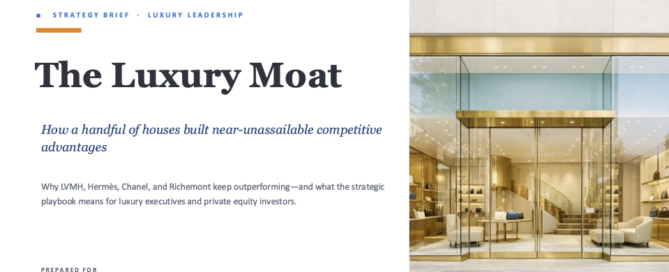
The Luxury Moat - How a handful of houses built near-unassailable competitive advantages Thousands of companies chase affluent consumers, yet a small group of European houses captures a disproportionate share of industry profit, customer loyalty, and brand equity. Their edge is not simply better products—it is a decades-deep operating system that competitors struggle to replicate. Click here to view the Executive Briefing
Customers no longer compare you only against direct competitors. They judge every experience against the most relevant, seamless, and personalized interaction they encounter anywhere. Hyperpersonalization has emerged as the strategic capability that separates market leaders from laggards — combining customer data, AI, predictive analytics, and real-time decisioning to deliver individualized experiences at scale. Click here to read the Executive Briefing.
The most strategically demanding holiday in years. Growth will stay positive, but it will be won on execution — not created by demand. The 2026 season is defined by persistent value-seeking, widening consumer income divergence, AI-enabled shopping, and continued margin pressure. Click here to view the Executive Briefing.
AI does not admire heritage, appreciate beautiful advertising, or experience your store. Instead, it builds a statistical representation of your company by synthesizing millions of digital signals across the internet. The quality of that understanding depends almost entirely on the consistency, clarity, and structure of your digital footprint. Click here to view the Executive Briefing.
Retail and consumer CEOs consistently rank generative AI among their highest capital-allocation priorities. CEOs now expect the growth rate of AI investment to more than double over the next two years. Yet investment alone has not produced transformation — pilots are plentiful, enterprise-wide impact is rare. Click here to view the Executive briefing.
The funnel is giving way to a network. For half a century, retailers organized marketing, merchandising, commerce, and experience around one idea: a predictable journey from awareness to loyalty. That framework is becoming obsolete. Artificial intelligence is changing how customers discover products, weigh alternatives, and decide — shifting from a linear funnel to dynamic, AI-mediated experiences where intelligent systems help manage the purchase. Click here to read the Executive Briefing.
Choosing investments in AI that pay off Some initiatives deliver ROI within months; others burn millions on impressive demos. The difference lies in choosing problems naturally suited for AI. The next generation of competitive advantage will belong not to organizations deploying the most AI — but to those deploying it in the highest-return areas first. Click on this link to view Executive Briefing
The New Retail Intelligence Race Artificial intelligence has moved from experimental novelty to competitive necessity. While most retailers run basic chatbots, a select group of leaders has gone far further — embedding predictive analytics, generative AI, autonomous agents, and computer vision across the entire business. AI Leaders in Retail Executive Briefing - Click here to view
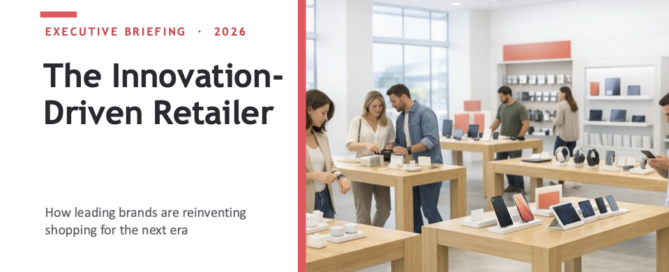
From Experimentation to AI-Powered Enterprises Artificial intelligence has moved from isolated pilots to enterprise-wide ecosystems spanning customer engagement, merchandising, operations, logistics, and product innovation. Organizations integrating AI across digital and physical channels are building durable competitive advantage. AI Powered Retail Executive Briefing - Click here to view